


Actual size and flowering may vary slightly based on season.
Brazilian Pepper
Brazilian Pepper is a fast-growing evergreen tree that gives relatively dense shade in a small space, about 20 to 30 feet tall and wide. Its glossy leaves smell peppery when crushed. Female trees carry clusters of bright red berries through fall and winter, and bees work the small summer flowers. It is used as a small shade tree, a screen or a background tree.
Best for: a small evergreen shade tree, screening and background planting, and bright red berries on female trees in fall and winter.
It grows fast to about 20 to 30 feet tall and wide and keeps its leaves all year. That makes it a good shade tree for a smaller yard where a big tree will not fit.
Left to grow, it forms a full, bushy canopy that screens a view. Train it while it is young if you want a single trunk and a clean shape.
Female trees carry clusters of red to pink berries through fall and winter. The small flowers draw bees, which make honey from them.
The sap can cause a skin rash in some people, so wear gloves and long sleeves when pruning. The berries are not edible. It reseeds and is invasive in some warm states, and it spreads near water in central Arizona, so pull seedlings early.
For the first two weeks, water a new tree every 1 to 2 days in summer, or every 3 to 4 days in cooler months. Ease to about weekly in summer by the second month, and keep up deep soaks for its first 3 years. Once rooted, water deeply on a regular schedule rather than letting it go bone dry for long.
It grows many crossing branches and weak wood. Train it to a few strong limbs while it is young, and stake it only until it can stand on its own.
Wear gloves and long sleeves when you prune, since the sap can cause a rash. Never take more than a quarter of the canopy in a year.
It reseeds, especially where water collects. Pull the seedlings while they are small.
Drainage test first. Dig the hole and fill it with water. If water is still sitting in the hole a day later, you likely hit caliche, clay or hard soil, so fix the drainage before planting. If it drains very fast, the soil is sandy. Standing water around roots is a common reason new plants fail.
Weed cloth. Cut it away from the planting hole and where the roots will spread. Remove any plastic sheeting completely, since it keeps water and air out of the soil.
Rock or decomposed granite with no soil underneath. Bring in soil close in texture to your native soil, mix it with the soil below, and build up enough depth for roots before planting.
If you can break through. Use a breaker bar, pick, or jackhammer. Dig through the caliche and break out the solid chunks. Backfill with the soil you dug out, with no compost or manure in the hole. Confirm drainage before planting.
If you cannot break through. Dig narrow holes through the hard layer beside the root ball, not under it, and refill them with the same soil, not gravel. If it still will not drain, plant on a low mound of the same soil.
Root ball. Check the outside edges for any roots circling around. Loosen or cut those so they grow outward. Do not break up the center of the root ball.
Depth. The top of the root ball should sit at or just slightly above the surrounding soil level. Planting too deep can lead to rot and kill the plant.
Drip emitters. At planting, put the emitters on the root ball, on different sides of the plant. After about 2 months, move them to the outer edge of the root ball. Over the first year, add emitters farther out toward the edge of the branches as roots grow. Once a plant is rooted, never water only at the trunk.
How big does Brazilian pepper get?
It grows fast to about 20 to 30 feet tall, with an equal or wider spread. Plant it where it has room for a broad canopy.
Is Brazilian pepper a good shade tree?
Yes, for a smaller yard. It keeps its leaves all year and gives fairly dense shade.
Can the sap irritate skin?
Yes. It is related to poison ivy, and its sap can cause a rash in some people. Wear gloves and long sleeves when you prune it, and wash afterward.
Are the red berries edible?
No, do not eat them. The berries can upset the stomach if eaten, so keep them away from children and pets.
Why do only some trees have berries?
Trees are either male or female, and only females carry the red berries. Nursery trees are not usually sold by sex.
How often should I water it?
Water it deeply on a regular schedule, and do not let it go bone dry for long. It does poorly when it is surrounded by hot rock or pavers.
Does it need pruning?
Yes. It grows many crossing branches and weak wood, so train and stake it while young and thin it to a few strong limbs.
Is Brazilian pepper invasive?
It is invasive in Florida, Hawaii and southern California, and it spreads in some areas near water in central Arizona. Pull seedlings when you see them.
How cold hardy is it?
It is rated to about 20°F. A hard freeze can make it drop its leaves.


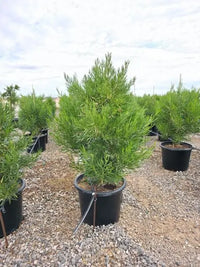
Brazilian Pepper for sale in Arizona, delivered to you
Brazilian Pepper is a fast, small evergreen shade tree with aromatic leaves and red berries on female trees. Below you will find its size, water and pruning needs, what to know about the berries and cold, and what to consider before you plant one.
Sourced from trusted Arizona growers and delivered directly to your door, job site, or property. We deliver across the Valley and to nearby towns, and quote delivery anywhere else in Arizona.
Is Brazilian pepper a good tree for Phoenix?
It is a fast, small evergreen shade tree with red berries on female trees. Give it regular deep water, and train it while it is young.
How big does a Brazilian pepper tree get?
It grows about 20 to 30 feet tall and wide, and the spread is often wider than the height.
What is the difference between Brazilian pepper and California pepper tree?
Brazilian pepper has broader, glossier leaves than the California pepper tree, and it yellows less in alkaline soil.
How often do you water Brazilian pepper?
Give it deep, regular water in soil that drains. Keep it away from hot rock and pavers, where it does poorly.
How do you prune a Brazilian pepper tree?
Train and stake it while it is young, and thin it to a few strong limbs so the weak wood does not split. Wear gloves and long sleeves, since the sap can cause a rash.
Are Brazilian pepper berries edible?
No. Female trees carry red berries through fall and winter, and they are decorative, not edible. Keep them away from children and pets.
We deliver across the Valley, from Phoenix, Scottsdale and Mesa out to San Tan Valley, Maricopa and Casa Grande, and up to Prescott, Sedona, Payson and Globe. See delivery areas and rates.