


Actual size and flowering may vary slightly based on season.
Indian Laurel Ficus Column
Indian laurel ficus is a fast, dense evergreen with glossy dark green leaves and a smooth gray trunk. Grown and sheared as a column, it makes a tall, narrow privacy screen along a wall or lot line. Columns planted 3 to 5 feet apart grow together into one green wall. It takes Valley summer heat and stays green all year.
Best for: tall privacy on a narrow strip, screening a neighbor's view year round, and big shade where it has room to grow.
Sheared as a column, it screens a neighbor's second story while staying about 3 to 5 feet wide. Columns planted 3 to 5 feet apart grow together into one green wall.
Its dense, glossy evergreen leaves block views all year. Trim it in late winter to keep the column tight and full.
Left unsheared, the same plant becomes a large shade tree 30 to 60 feet tall with dense shade. That only works in open ground with plenty of room to spread.
Its roots spread near the surface and can lift paving, so keep it away from pools, patios and the house. A hard freeze can brown the leaves, and the smooth trunk can sunburn on hot west sides.
- Faster fill privacy row3 ft apart
- Standard privacy row4-5 ft apart
For the first two weeks, water a new tree every 1 to 2 days in summer, or every 3 to 4 days in cooler months. Ease to about weekly in summer by the second month. Keep up deep, regular soaks for its first 3 years.
Deep watering keeps its roots from spreading at the surface. Once rooted, soak it 2 to 3 feet deep about every 7 to 14 days in summer and every 2 to 4 weeks in winter. Water at the drip line, not the trunk.
Trim the column in late winter, from about February to March. Avoid heavy summer trimming, which exposes bark to sunburn. Keep the trunk shaded and away from hot west walls.
It can be damaged below about 25°F. Cover young trees with frost cloth on freeze nights. If frost browns the leaves, wait until frost danger passes, about March, before cutting off the dead growth.
Drainage test first. Dig the hole and fill it with water. If water is still sitting in the hole a day later, you likely hit caliche, clay or hard soil, so fix the drainage before planting. If it drains very fast, the soil is sandy. Standing water around roots is a common reason new plants fail.
Weed cloth. Cut it away from the planting hole and where the roots will spread. Remove any plastic sheeting completely, since it keeps water and air out of the soil.
Rock or decomposed granite with no soil underneath. Bring in soil close in texture to your native soil, mix it with the soil below, and build up enough depth for roots before planting.
If you can break through. Use a breaker bar, pick, or jackhammer. Dig through the caliche and break out the solid chunks. Backfill with the soil you dug out, with no compost or manure in the hole. Confirm drainage before planting.
If you cannot break through. Dig narrow holes through the hard layer beside the root ball, not under it, and refill them with the same soil, not gravel. If it still will not drain, plant on a low mound of the same soil.
Root ball. Check the outside edges for any roots circling around. Loosen or cut those so they grow outward. Do not break up the center of the root ball.
Depth. The top of the root ball should sit at or just slightly above the surrounding soil level. Planting too deep can lead to rot and kill the plant.
Drip emitters. At planting, put the emitters on the root ball, on different sides of the plant. After about 2 months, move them to the outer edge of the root ball. Over the first year, add emitters farther out toward the edge of the branches as roots grow. Once a plant is rooted, never water only at the trunk.
How fast does Indian laurel ficus grow?
It grows fast with regular water, which makes it one of the quickest ways to get a tall screen. Deep, regular soaks keep it growing well.
How tall and wide does the column get?
Kept sheared, columns are usually held at 10 to 30 feet tall and about 3 to 5 feet wide. Left alone, it grows into a tree 30 to 60 feet tall.
How far apart should I plant them for privacy?
Plant them about 3 to 5 feet apart. At that spacing the columns grow together into a solid green wall.
Are the roots really a problem?
The roots can be a problem because they spread near the surface and can lift paving, so plant it well away from pools, patios and the house. Long, deep waterings help push the roots deeper.
How often should I water it?
Once it is rooted, water deeply every 1 to 2 weeks in summer and every 2 to 4 weeks in winter. Young trees need water more often for their first few years.
Is it cold hardy in Phoenix?
Established trees are hardy in Phoenix, though a hard freeze can burn leaves and young branches. Newly planted trees are more tender, so cover them on the coldest nights.
My ficus froze. What do I do?
Leave the brown growth in place until frost danger passes, around the end of February or early March. Established trees usually leaf back out, and then you can see where to cut.
Can the trunk get sunburned?
Yes. The smooth gray bark can burn on hot, reflective west sides. Keep the leaves low enough to shade the trunk, and avoid heavy summer pruning.
How often does the column need trimming?
It takes trimming well and can be shaped most of the year. Do the main trim in late winter, from about February to March, and avoid heavy cuts in summer.
Is it safe for dogs and cats?
No. The plant is toxic to dogs, cats and horses if chewed, and the milky sap irritates skin. Plant it where pets will not chew on it.
When is the best time to plant it?
Fall is the best time to plant, and late winter to early spring works too. Avoid planting in the summer heat, when new trees struggle.
Why are my ficus leaves curled and rolled up?
Rolled, pod-like new leaves with dark marks are usually Cuban laurel thrips, most common from midsummer to fall. The damage is mostly cosmetic, so cut off the rolled tips in winter.
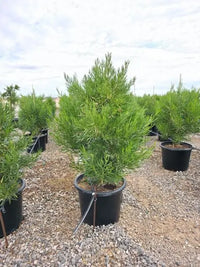


Indian Laurel Ficus Column for sale in Arizona, delivered to you
Indian laurel ficus is one of the most popular trees for tall privacy in the Valley. Sheared as a column, it screens a second story without eating yard space and stays green year round. Below are the questions people ask most about growing it here.
Sourced from trusted Arizona growers and delivered directly to your door, job site, or property. We deliver across the Valley and to nearby towns, and quote delivery anywhere else in Arizona.
Ficus columns for privacy in Phoenix
Plant columns 3 to 5 feet apart along a wall or lot line and they grow into a solid green screen. Trim them in late winter to keep them narrow.
How fast does ficus grow in Phoenix?
It grows fast with regular deep water, so a row can screen a second story within a few seasons.
Ficus roots: how far from the pool and house
The roots spread near the surface and can lift paving. Plant it well away from pools, patios and the house, and water deeply to push roots down.
Frost damage on ficus
A hard freeze can burn leaves and young branches. Established trees usually recover by spring, while new plantings are more tender. Wait until about March before pruning off damage.
Watering ficus in the desert
Water deeply every 1 to 2 weeks in summer and every 2 to 4 weeks in winter. Long, deep soaks keep the column full and the roots deeper.
Protecting the trunk from sunburn
The smooth gray trunk can sunburn on hot west sides. Let the leaves shade the trunk and avoid heavy summer pruning.
Ficus and pets
The plant is toxic to dogs, cats and horses if chewed, and the milky sap irritates skin.
We deliver across the Valley, from Phoenix, Scottsdale and Mesa out to San Tan Valley, Maricopa and Casa Grande, and up to Prescott, Sedona, Payson and Globe. See delivery areas and rates.