

Actual size and flowering may vary slightly based on season.
Joshua Tree
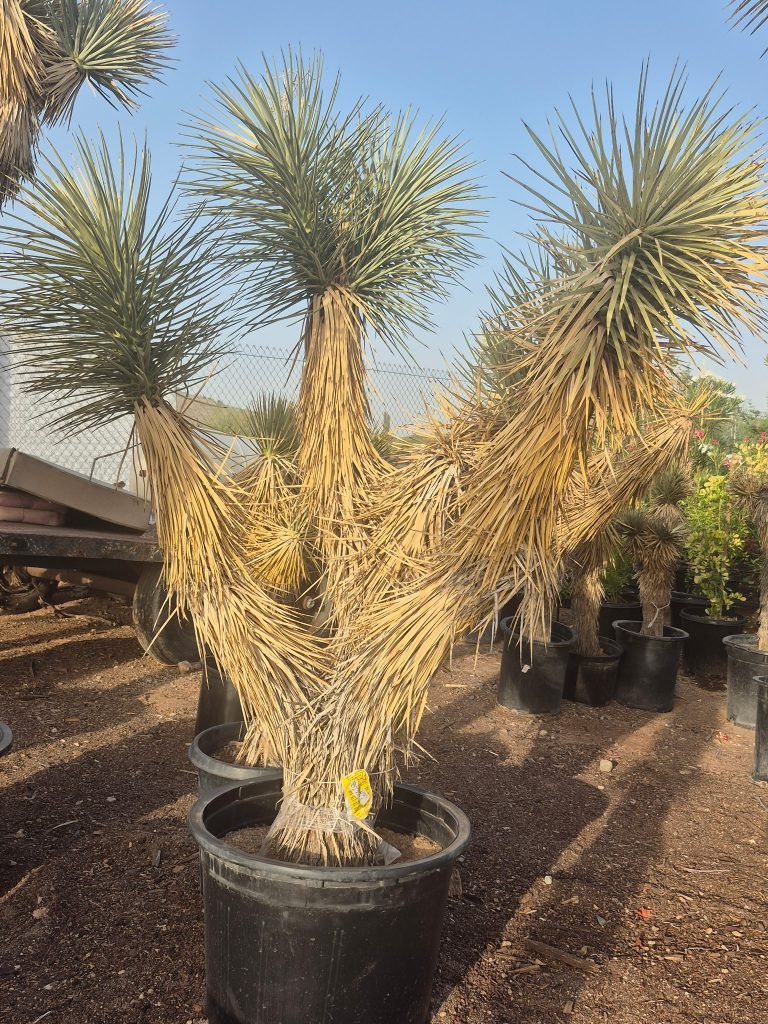
The Joshua tree is the iconic tree yucca of the Mojave Desert, native to northwest Arizona, Nevada, California and Utah. It starts as a single trunk and slowly branches into many arms, eventually reaching 15 to 30 feet tall. In spring it sends up stalks of white, bell-shaped flowers. It is a slow, long-term specimen for full sun and very well-drained soil. Joshua trees are priced by the foot of height, so sizes and pricing are on request.
Best for: a long-term native specimen in full sun, gravelly or rocky soil that drains fast, and large yards with room to branch.
It is one of the signature plants of the Mojave Desert and grows wild in northwest Arizona. One plant makes a long-term specimen in a large desert yard.
Young plants grow on a single trunk and slowly branch into multiple arms. Mature trees reach 15 to 30 feet tall and 10 to 15 feet wide.
Plant it in full sun in gravelly or rocky soil that drains very fast. Once it is rooted it needs water only rarely, and none in winter.
Poor drainage is the fastest way to lose it, and it struggles in Phoenix when summer heat goes above about 112°F. It does not transplant well, so a nursery-grown plant is a better choice than a dug one. Growth is also very slow while it is young.
- Closer grouping12 ft apart
- Grouped trees12-20 ft apart
Keep the root area slightly damp until a new plant roots in, then stretch the time between waterings. Once rooted, water it only rarely, with a deep soak in long hot, dry spells, and give no extra water in winter. Let the soil dry between soakings.
Joshua trees do not transplant well, so choose the spot carefully and leave it there. Plant it at the same depth it grew, with the same side facing south. It does not need any fertilizer.
Old leaves fold down into a shaggy skirt, and removing them is optional. Cut each spent flower stalk low after it finishes, and it will bloom again in later years.
Snout weevils are the main insect pest of yuccas. Leaves wilt or lean, the base goes soft, and the plant collapses. Good drainage and little water once rooted keep it healthy. Remove a collapsed plant and the soil around it so grubs do not spread.
It is rated to about -10°F. Keep the soil on the dry side in winter, since wet, cool soil leads to rot.
Drainage test first. Dig the hole and fill it with water. If water is still sitting in the hole a day later, you likely hit caliche, clay or hard soil, so fix the drainage before planting. If it drains very fast, the soil is sandy. Standing water around roots is a common reason new plants fail.
Weed cloth. Cut it away from the planting hole and where the roots will spread. Remove any plastic sheeting completely, since it keeps water and air out of the soil.
Rock or decomposed granite with no soil underneath. Bring in soil close in texture to your native soil, mix it with the soil below, and build up enough depth for roots before planting.
If you can break through. Use a breaker bar, pick, or jackhammer. Dig through the caliche and break out the solid chunks. Backfill with the soil you dug out, with no compost or manure in the hole. Confirm drainage before planting.
If you cannot break through. Dig narrow holes through the hard layer beside the root ball, not under it, and refill them with the same soil, not gravel. If it still will not drain, plant on a low mound of the same soil.
Root ball. Check the outside edges for any roots circling around. Loosen or cut those so they grow outward. Do not break up the center of the root ball.
Depth. The top of the root ball should sit at or just slightly above the surrounding soil level. Planting too deep can lead to rot and kill the plant.
Drip emitters. At planting, put the emitters on the root ball, on different sides of the plant. After about 2 months, move them to the outer edge of the root ball. Over the first year, add emitters farther out toward the edge of the branches as roots grow. Once a plant is rooted, never water only at the trunk.
Can a Joshua tree grow in the Valley?
It grows wild in the Mojave Desert at about 1,300 to 5,900 feet, including northwest Arizona. It struggles when summer air goes above about 112°F, so it is a harder plant to keep in Phoenix than in cooler parts of the state. In a Valley yard, give it full sun, very fast-draining soil and no winter water.
Is the Joshua tree native to Arizona?
Yes. It grows wild in northwest Arizona, as well as in Nevada, California and Utah.
How big does a Joshua tree get?
Most mature trees reach 15 to 30 feet tall and 10 to 15 feet wide, so plan a spot with room for the arms.
How fast does a Joshua tree grow?
It grows slowly, and very slowly when young. It takes many years to branch into arms.
How far apart should Joshua trees be planted?
Plant them about 12 to 20 feet apart. The Spacing tab has the details.
How often should I water a Joshua tree?
Water new plants more often until they root in. After that, water rarely, only in long hot, dry spells, and let the soil dry out between waterings. Give no extra water in winter.
What soil does a Joshua tree need?
Very well-drained, gravelly to rocky soil is a must. If you hit caliche, dig through it so the hole drains.
Can I move a Joshua tree from the wild?
It does not transplant well, and dug trees can struggle. Nursery-grown plants are the recommended choice.
When does a Joshua tree bloom?
It blooms in spring, with stalks of white, bell-shaped flowers. It does not die after blooming.
Is the Joshua tree cold hardy?
Yes, it is very cold hardy, rated to about -10°F. It needs no frost protection in the Valley.
Is a Joshua tree toxic to pets?
Yucca is listed as toxic to dogs, cats and horses, and chewing it usually causes vomiting in dogs and cats. The stiff, pointed leaves can also injure a pet, so plant it where pets do not play.


Joshua Tree for sale in Arizona, delivered to you
The Joshua tree is the tree yucca that defines the Mojave Desert, and it is native to northwest Arizona. It grows slowly from a single trunk into a branched tree. Below are answers to the questions homeowners ask most before planting one in the Valley.
Sourced from trusted Arizona growers and delivered directly to your door, job site, or property. We deliver across the Valley and to nearby towns, and quote delivery anywhere else in Arizona.
Can a Joshua tree grow in Phoenix?
It grows wild in the Mojave Desert at about 1,300 to 5,900 feet, including northwest Arizona. In a Valley yard, give it full sun, very fast-draining soil and no winter water. It struggles when summer heat goes above about 112°F, so expect it to be harder to keep in the low desert.
Is the Joshua tree native to Arizona?
Yes. Its range covers northwest Arizona along with Nevada, California and Utah. It is one of the signature plants of the Mojave Desert.
How big do Joshua trees get?
Plan for 15 to 30 feet tall and 10 to 15 feet wide at maturity. It starts on one trunk and branches into arms over many years.
How often do you water a Joshua tree?
Water new plants more often until they root in, then rarely. Skip extra water in winter, and let the soil dry out between waterings.
How far apart do you plant Joshua trees?
Space them about 12 to 20 feet apart. Each tree can spread 10 to 15 feet.
Should you buy a nursery-grown Joshua tree?
Yes. Joshua trees do not transplant well, so nursery-grown plants are the recommended choice.
We deliver across the Valley, from Phoenix, Scottsdale and Mesa out to San Tan Valley, Maricopa and Casa Grande, and up to Prescott, Sedona, Payson and Globe. See delivery areas and rates.