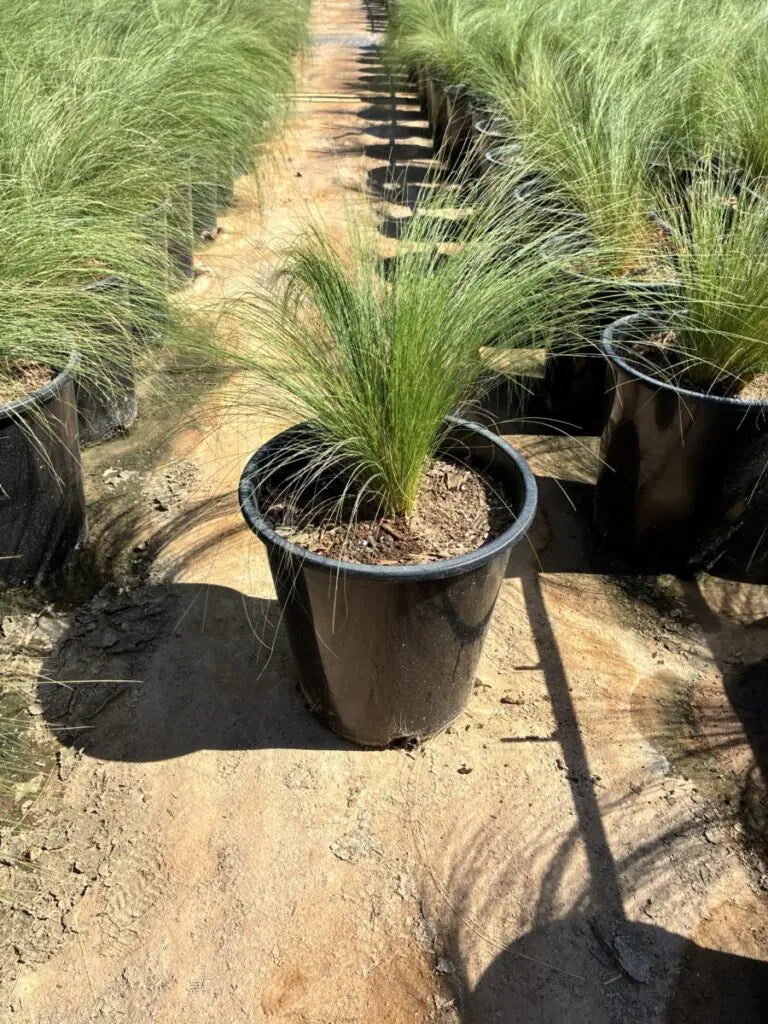

Actual size and flowering may vary slightly based on season.
Mexican Thread Grass
Mexican Thread Grass forms a soft clump of fine, thread-like leaves that sway in the lightest breeze. It is bright green in the warm months and turns gold as the weather cools. It stays about 1 to 2 feet tall and wide, and it works as an accent, in groups or in a large container. In the low desert it looks best with some light shade.
Best for: soft texture and movement in a desert bed, groups of accent grasses, large containers, and spots with light afternoon shade.
The fine, thread-like leaves sway in any breeze and soften the look of rocks and spiky plants. It is bright green in summer and gold in the cool months.
It looks best planted in groups as an accent and viewed from a little distance. Keep it in beds with clear edges.
Its 1 to 2 foot clump fits a large container, where its spread is easy to control.
It reseeds, and it can spread beyond where you want it, especially with overhead watering or in wetter spots. Water it with drip and keep it in bounded beds.
- Tight mass planting18 in apart, center to center
- Looser planting24 in apart, center to center
Water a new plant regularly while it roots in. Once rooted, a deep soak every week or two in summer keeps it full. Use drip rather than overhead spray to limit reseeding.
Cut it back in early spring to remove the dormant leaves and dried seed heads. Fresh green growth follows within a few weeks.
It reseeds and can spread past its bed. Pull unwanted seedlings while small, and keep it away from open desert.
Turns tan in winter and greens up again in spring.
Drainage test first. Dig the hole and fill it with water. If water is still sitting in the hole a day later, you likely hit caliche, clay or hard soil, so fix the drainage before planting. If it drains very fast, the soil is sandy. Standing water around roots is a common reason new plants fail.
Weed cloth. Cut it away from the planting hole and where the roots will spread. Remove any plastic sheeting completely, since it keeps water and air out of the soil.
Rock or decomposed granite with no soil underneath. Bring in soil close in texture to your native soil, mix it with the soil below, and build up enough depth for roots before planting.
If you can break through. Use a breaker bar, pick, or jackhammer. Dig through the caliche and break out the solid chunks. Backfill with the soil you dug out, with no compost or manure in the hole. Confirm drainage before planting.
If you cannot break through. Dig narrow holes through the hard layer beside the root ball, not under it, and refill them with the same soil, not gravel. If it still will not drain, plant on a low mound of the same soil.
Root ball. Check the outside edges for any roots circling around. Loosen or cut those so they grow outward. Do not break up the center of the root ball.
Depth. The top of the root ball should sit at or just slightly above the surrounding soil level. Planting too deep can lead to rot and kill the plant.
Drip emitters. At planting, put the emitters on the root ball, on different sides of the plant. After about 2 months, move them to the outer edge of the root ball. Over the first year, add emitters farther out toward the edge of the branches as roots grow. Once a plant is rooted, never water only at the trunk.
How big does Mexican thread grass get?
It usually grows about 1 to 2 feet tall and wide, forming a soft round clump.
Does Mexican thread grass reseed?
Yes, it reseeds and can spread past where you planted it. Water with drip rather than spray, and plant it in beds with clear edges so seedlings are easy to pull.
Is Mexican thread grass invasive?
It is reported to be invasive in wetter places, and it naturalizes in the landscape. Keep it on drip, pull seedlings, and avoid planting it next to open desert.
Does it need shade in Phoenix?
Filtered sun or light shade is best in the low desert. In cooler, higher areas it takes full sun.
How often should I water it?
It is a low-water grass once rooted. A deep soak every week or two in summer keeps it full and green.
When should I cut it back?
Cut it back in early spring to remove the old, dormant leaves and dried seed heads.
Why is my thread grass turning gold?
It naturally turns gold as the weather cools. Fresh green growth returns in spring after you cut it back.
How long does it live?
It is fairly short-lived, and seedlings often replace the older clumps. Pull any you do not want while they are small.


Mexican Thread Grass for sale in Arizona, delivered to you
Mexican Thread Grass is a soft, fine-textured clumping grass that moves with every breeze and turns gold in cool weather. Below: size, sun, water, cutting back, reseeding and how to keep it in bounds.
Sourced from trusted Arizona growers and delivered directly to your door, job site, or property. We deliver across the Valley and to nearby towns, and quote delivery anywhere else in Arizona.
Mexican thread grass in Phoenix
A soft, clumping grass with fine leaves that turn from green to gold. In the low desert it does best with some light shade.
Does Mexican feather grass spread?
Yes, it reseeds and can spread. Water it with drip and keep it in bounded beds to limit seedlings.
When to cut back Mexican thread grass
Cut it back in early spring to clear old leaves and dried seed heads before new growth.
Watering Mexican thread grass
Water deeply every week or two in summer once it is rooted. Drip keeps it healthy and limits reseeding.
Mexican thread grass in pots
Its 1 to 2 foot clump fits a large container, where it is easy to keep in bounds.
Mexican thread grass sun needs
Filtered sun or light afternoon shade suits it in the low desert.
We deliver across the Valley, from Phoenix, Scottsdale and Mesa out to San Tan Valley, Maricopa and Casa Grande, and up to Prescott, Sedona, Payson and Globe. See delivery areas and rates.