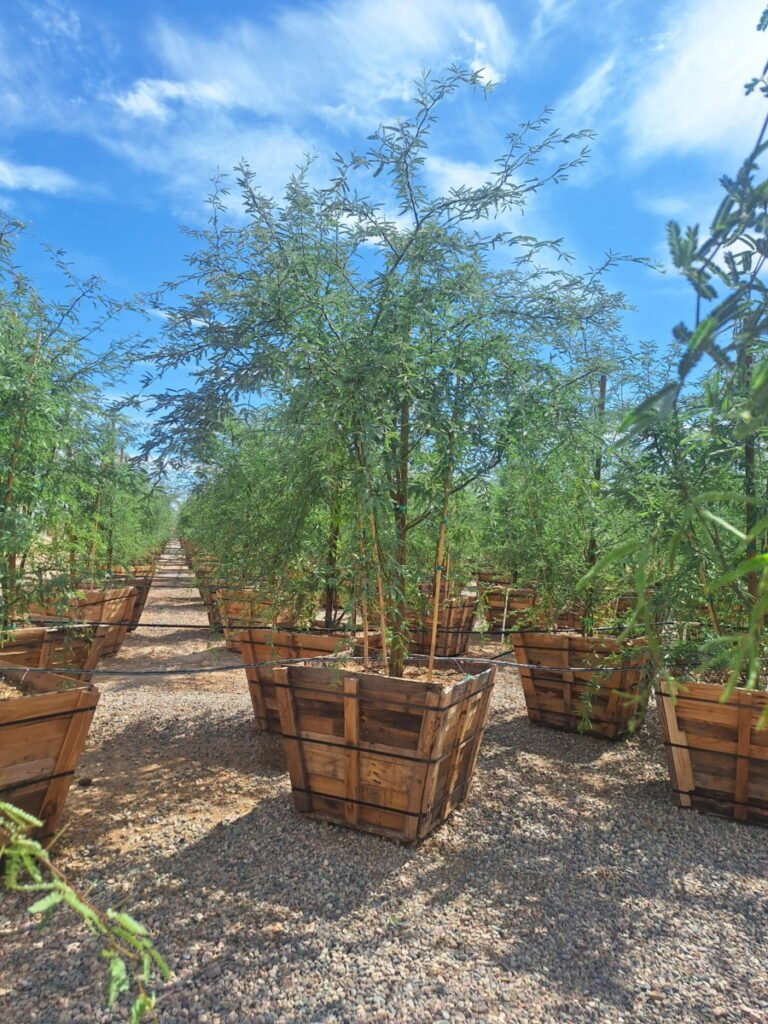


Actual size and flowering may vary slightly based on season.
Native Mesquite
Native Mesquite, also called Velvet Mesquite, is the shade tree that grows wild in the Sonoran Desert around Phoenix and Tucson. Its small, ferny leaves make light, filtered shade, so plants can still grow underneath. It roots deep and stands up to monsoon wind far better than Chilean mesquite. Bees, birds and other desert wildlife use its flowers, pods and branches.
Best for: filtered shade on low water, a tree that holds up in monsoon wind, and native yards that feed bees, birds and wildlife.
The small leaves make dappled shade, so plants underneath still get light. Once rooted it needs only a deep soak about every 2 to 3 weeks in summer and about once a month in winter. Plant it 20 feet or more from other trees.
Velvet Mesquite roots deep, and established trees rarely blow over. Deep, infrequent watering at the edge of the canopy builds those roots, while light watering at the trunk keeps them shallow.
Bees visit the yellow flower spikes, and birds and other wildlife eat the pods and seeds. The branches give birds cover and places to nest.
It has thorns, drops pods and small leaves, and can drip dark sap, so keep it to the side of a pool, patio or parking spot. Heavy watering pushes fast, weak growth that breaks in storms.
- Row of shade trees20 ft apart
- Single shade tree20+ ft apart
For the first two weeks, water a new tree every 1 to 2 days in summer, or every 3 to 4 days in cooler months. Ease to about weekly in summer by the second month, and keep up deep, regular soaks for its first 3 years. Once rooted, soak it 2 to 3 feet deep at the canopy edge about every 2 to 3 weeks in summer and about once a month in winter.
Take off the nursery stake at planting, and stake only if the tree cannot stand on its own or sits in a windy spot. Use two stakes outside the root ball and soft, wide ties that let the trunk sway. Remove them after about a year. Mesquites grow top-heavy, so many need stakes the first year.
Train a young tree to one strong trunk or a few well-spaced ones, a little at a time. On older trees, raise the canopy and cut suckers and water sprouts. Never take more than a quarter of the leaves in a year, and do not strip the inside branches bare. Finish any thinning before monsoon season starts in mid-June.
Extra water pushes fast, weak wood that breaks or blows over in monsoon storms. Light, frequent watering also keeps roots shallow. Water deep and less often.
Desert mistletoe is common on mesquite, and birds spread the seeds. It is easiest to spot in winter. Cut infected branches at least a foot below the clump, since brushing it off lets it grow back.
Drainage test first. Dig the hole and fill it with water. If water is still sitting in the hole a day later, you likely hit caliche, clay or hard soil, so fix the drainage before planting. If it drains very fast, the soil is sandy. Standing water around roots is a common reason new plants fail.
Weed cloth. Cut it away from the planting hole and where the roots will spread. Remove any plastic sheeting completely, since it keeps water and air out of the soil.
Rock or decomposed granite with no soil underneath. Bring in soil close in texture to your native soil, mix it with the soil below, and build up enough depth for roots before planting.
If you can break through. Use a breaker bar, pick, or jackhammer. Dig through the caliche and break out the solid chunks. Backfill with the soil you dug out, with no compost or manure in the hole. Confirm drainage before planting.
If you cannot break through. Dig narrow holes through the hard layer beside the root ball, not under it, and refill them with the same soil, not gravel. If it still will not drain, plant on a low mound of the same soil.
Root ball. Check the outside edges for any roots circling around. Loosen or cut those so they grow outward. Do not break up the center of the root ball.
Depth. The top of the root ball should sit at or just slightly above the surrounding soil level. Planting too deep can lead to rot and kill the plant.
Drip emitters. At planting, put the emitters on the root ball, on different sides of the plant. After about 2 months, move them to the outer edge of the root ball. Over the first year, add emitters farther out toward the edge of the branches as roots grow. Once a plant is rooted, never water only at the trunk.
How big does Native Mesquite get?
It usually grows about 20 to 30 feet tall and 20 to 30 feet wide. Plant it 20 feet or more from other trees so the canopy can spread without constant cutting.
Will it blow over in a monsoon?
Established Velvet Mesquites rarely blow over because they root deep. When a mesquite does go over, it's usually from shallow roots caused by light watering at the trunk. Water deep and out at the edge of the canopy.
Native Mesquite or Chilean Mesquite?
Chilean grows faster but roots shallow, often lifts sidewalks, and is the tree most often blown over in monsoons. Velvet Mesquite is slower but deep rooted, stronger wooded, and feeds native wildlife.
How much water does it need?
Water regularly while it gets established. After that it needs little, but most Phoenix yards still give it occasional deep watering. Water deep and not often.
Does it have thorns?
Yes. It has small, sharp thorns, and young growth tends to be the thorniest. Keep it back from paths where kids play, and wear gloves when you prune.
Is it messy?
It drops pods and small leaves and can drip dark sap. Rake up the pods or leave some for wildlife, and plant it to the side of a pool, patio or parking spot, not over it.
How should I prune it?
Train a young tree to one strong trunk or a few well-spaced ones, a little at a time. Thin the canopy if it gets too thick, and finish before monsoon season starts in mid-June.
Is it evergreen?
No. It drops its leaves in winter, often around December, and leafs out again in spring.
Is it cold hardy?
Yes. It handles about 0 to 5°F, far colder than the Valley gets, so it needs no frost cover.
What's the clumpy growth in my mesquite?
Usually desert mistletoe, a native parasite. Cut small infested branches off at least a foot below where it attaches. On big limbs, trim it flush and plan to re-trim, since it grows back.
How far apart should I plant native mesquite?
Plant them 20 feet or more apart. That gives each canopy room to spread to its full 20 to 30 feet. The Spacing tab shows the numbers.
Can Native Mesquite bother allergies or skin?
Yes, it can. Its pollen can bother people with allergies. The leaves can also irritate skin, so wear gloves and long sleeves when you prune.


Native Mesquite for sale in Arizona, delivered to you
Native Mesquite, or Velvet Mesquite, is the shade tree that grows wild across the Sonoran Desert. It gives light shade on low water, roots deep enough to stand up to monsoon wind, and feeds birds, bees and wildlife. Below is what to expect in a Valley yard: size, spacing, water, pruning and how it compares with Chilean mesquite.
Sourced from trusted Arizona growers and delivered directly to your door, job site, or property. We deliver across the Valley and to nearby towns, and quote delivery anywhere else in Arizona.
Native Mesquite vs Chilean Mesquite
Chilean mesquite grows faster and stays greener, but it roots shallow, often lifts sidewalks, and is the tree most often blown over in monsoon storms. Velvet Mesquite grows slower but roots deep, rarely shows surface roots, and rarely blows over once established.
Does Native Mesquite blow over?
Established Velvet Mesquites rarely do. Most mesquites that go over in a storm had shallow roots from light, frequent watering right at the trunk. Deep watering out at the edge of the canopy grows roots that hold the tree up.
How big does Native Mesquite get?
Plan on about 20 to 30 feet tall with a spread of up to about 30 feet. Give it room so the canopy can spread without constant cutting.
How to water a Native Mesquite
Water regularly while it gets established. Deep watering about once a week while it has leaves gives the best growth. Older trees can get by on less, but they grow slower. Put the water out at the edge of the canopy.
Thorns, pods, and sap
It has thorns, drops pods and small leaves, and can drip dark sap. Plant it in the yard, to the side of a pool, patio or car, rather than hanging over it.
Native Mesquite and wildlife
The flowers feed bees, with a second bloom often after summer rains. The pods feed birds, rabbits, squirrels, javelina, and coyotes, and the tree gives birds cover and places to nest.
Edible mesquite pods
Velvet Mesquite pods are edible and have long been ground into flour. Many people also leave some pods on the ground for wildlife.
Is Native Mesquite cold hardy?
Yes, to about 0 to 5°F. It drops its leaves in winter, often around December, and leafs out again in spring.
How far apart to plant native mesquite
Space native mesquites about 20 feet apart or more. Each tree can spread 20 to 30 feet, so wider spacing means less pruning later.
We deliver across the Valley, from Phoenix, Scottsdale and Mesa out to San Tan Valley, Maricopa and Casa Grande, and up to Prescott, Sedona, Payson and Globe. See delivery areas and rates.