

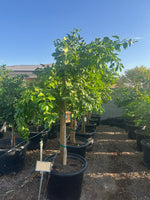

Actual size and flowering may vary slightly based on season.
Ruby Red Grapefruit
Ruby Red is the classic pink grapefruit, long a favorite in Valley backyards. It grows into a large, rounded evergreen tree, and its white spring blossoms are highly fragrant. The fruit has pink flesh and only a few seeds. It is ready to pick from December and keeps getting better the longer it hangs on the tree.
Best for: a backyard fruit tree, pink grapefruit to pick from winter into spring, spring blossom scent near a patio, and a large evergreen tree for a sunny yard.
Ruby Red grows into a large, rounded evergreen tree, about 15 to 20 feet tall and wide. Plant it in full sun, about 12 to 20 feet from other trees. Keep it away from a hot west wall, where the afternoon sun can burn fruit and bark.
The fruit is ready from December, but it keeps getting better on the tree. It holds well into spring, so you can pick as you need it. The pink flesh slowly fades toward gold as spring comes on.
White blossoms open in late winter and spring, and they are highly fragrant. Bees visit the flowers, and citrus blossoms are a main source of spring honey in Arizona.
Young trees need frost cloth on freezing nights. Bare trunks sunburn in the Valley sun if the low branches are cut off. It drops leaves, blossoms and fruit, and blossoms can clog a pool filter.
- Grapefruit trees in a rowAbout 12 to 15 ft apart
- Single tree in the yardAbout 20 ft from other trees
A young grapefruit tree needs water every few days in its first months, and more often in summer. Soak the soil out past the branch tips, not just at the trunk.
Soak the soil 2 to 3 feet deep about every 7 to 14 days in summer and every 3 to 4 weeks in winter. Let the top of the soil dry out between waterings.
Feed with a citrus fertilizer three times a year. Give one feeding in January or February, one in March or April, and one in May or June.
Prune lightly from late winter into spring, and skip summer pruning. Leave the low branches to shade the trunk, and paint any bare bark with white latex paint.
Grapefruit trees are rated to about 26°F. On freezing nights, cover young trees with frost cloth all the way to the ground, and water the day before.
Drainage test first. Dig the hole and fill it with water. If water is still sitting in the hole a day later, you likely hit caliche, clay or hard soil, so fix the drainage before planting. If it drains very fast, the soil is sandy. Standing water around roots is a common reason new plants fail.
Weed cloth. Cut it away from the planting hole and where the roots will spread. Remove any plastic sheeting completely, since it keeps water and air out of the soil.
Rock or decomposed granite with no soil underneath. Bring in soil close in texture to your native soil, mix it with the soil below, and build up enough depth for roots before planting.
If you can break through. Use a breaker bar, pick, or jackhammer. Dig through the caliche and break out the solid chunks. Backfill with the soil you dug out, with no compost or manure in the hole. Confirm drainage before planting.
If you cannot break through. Dig narrow holes through the hard layer beside the root ball, not under it, and refill them with the same soil, not gravel. If it still will not drain, plant on a low mound of the same soil.
Root ball. Check the outside edges for any roots circling around. Loosen or cut those so they grow outward. Do not break up the center of the root ball.
Depth. The top of the root ball should sit at or just slightly above the surrounding soil level. Planting too deep can lead to rot and kill the plant.
Drip emitters. At planting, put the emitters on the root ball, on different sides of the plant. After about 2 months, move them to the outer edge of the root ball. Over the first year, add emitters farther out toward the edge of the branches as roots grow. Once a plant is rooted, never water only at the trunk.
How big does a Ruby Red grapefruit tree get?
A standard tree grows about 15 to 20 feet tall and about as wide, and old trees can get larger. Semi-dwarf grapefruit trees stay smaller, at about 8 to 15 feet.
How far apart should I plant grapefruit trees?
Plant them about 12 to 15 feet apart in a row. Give a single tree about 20 feet from other trees. The Spacing tab can count trees for a row.
When is Ruby Red grapefruit ready to pick?
You can start picking in December. The fruit keeps getting sweeter on the tree and holds well into spring, so many people pick most of it in late winter or spring.
Is Ruby Red the same as Redblush?
Yes, for home growing they are treated as the same grapefruit. Both came from the same Texas pink grapefruit around 1930, and Redblush is the more common name in Arizona.
What is the difference between Ruby Red and Rio Red?
Rio Red came later from the Ruby Red line and has darker red flesh. Ruby Red flesh is light pink and fades toward gold by spring. Both grow into large, vigorous trees.
Is red grapefruit sweeter than white grapefruit?
No, not really. Red and white grapefruit are about equally sweet when the fruit is left to ripen fully on the tree, so give it time before you pick.
How cold can a grapefruit tree take?
It is rated to about 26°F. Cover young trees with frost cloth to the ground on freezing nights, and water the day before.
How often should I water a grapefruit tree?
Water deeply, 2 to 3 feet down and out past the branch tips. Established trees need water about every 7 to 14 days in summer and every 3 to 4 weeks in winter. Young trees need water every few days at first.
When should I fertilize it?
Split the year's citrus fertilizer into three feedings. Apply one in January or February, one in March or April, and one in May or June.
When should I prune it, and why paint the trunk?
Prune lightly in late winter or spring, not in summer. Keep the low branches, because they shade the trunk from sunburn. Paint any bare, sun-hit bark with white latex paint or whitewash.
Is it messy? Can it go near a pool?
It drops leaves through the year, plus spent blossoms and fruit, so pick up fallen fruit promptly. Dropped blossoms can overload a pool filter, so keep it back from the water.
Is a grapefruit tree safe for dogs and cats?
No. Grapefruit is listed as toxic to dogs, cats and horses. Chewing the peel, leaves or stems can cause vomiting, diarrhea and depression.


Ruby Red Grapefruit for sale in Arizona, delivered to you
Ruby Red, also sold as Redblush, has long been one of the most popular pink grapefruits grown in the Valley. It brings a large evergreen tree, scented spring blossoms and a winter crop of pink fruit. Below are the questions homeowners ask most, from size, spacing and harvest time to watering, feeding and frost.
Sourced from trusted Arizona growers and delivered directly to your door, job site, or property. We deliver across the Valley and to nearby towns, and quote delivery anywhere else in Arizona.
How big does a Ruby Red grapefruit tree get?
A standard Ruby Red grows about 15 to 20 feet tall and about as wide, with a rounded evergreen canopy. It grows at a moderate rate, and old trees can get larger.
How far apart do you plant grapefruit trees?
Plant grapefruit trees about 12 to 15 feet apart in a row. Give a single tree about 20 feet from other trees. The spacing calculator can count trees for a row.
When to pick Ruby Red grapefruit in Arizona
Ruby Red can be picked from December. The fruit gets sweeter the longer it hangs and holds well into spring, while the pink flesh slowly fades toward gold.
Ruby Red vs Rio Red grapefruit
Rio Red came from the Ruby Red line and has darker red flesh. Ruby Red, also called Redblush, has light pink flesh with only a few seeds.
Watering a grapefruit tree in Phoenix
Water deeply, wetting the soil 2 to 3 feet down and out past the branch tips. Established trees need water about every 7 to 14 days in summer and every 3 to 4 weeks in winter.
When to fertilize grapefruit in the Valley
Grapefruit gets three feedings a year. Apply one in January or February, one in March or April, and one in May or June.
Is grapefruit cold hardy in Phoenix?
Grapefruit trees are rated to about 26°F. Cover young trees with frost cloth to the ground on freezing nights, and water the day before a freeze.
We deliver across the Valley, from Phoenix, Scottsdale and Mesa out to San Tan Valley, Maricopa and Casa Grande, and up to Prescott, Sedona, Payson and Globe. See delivery areas and rates.