


Actual size and flowering may vary slightly based on season.
White Crape Myrtle
White Crape Myrtle is the Natchez variety, a fast grower that fills with clusters of pure white flowers through the summer heat. Its bark peels away to show smooth cinnamon brown trunks, and the leaves turn orange and red in fall before they drop. Natchez is known for strong resistance to powdery mildew. Give it full sun and regular deep water and it can grow into a medium shade tree for a lawn, patio edge or front yard.
Best for: a summer-flowering shade tree in a watered yard, a row along a drive or property line, or a multi-trunk tree with peeling bark.
Most people buy it for the white flowers in the heat of summer. Flowers can run from about June into September. With full sun and regular deep water it can grow into a medium shade tree over a lawn, patio edge or front yard bed.
Natchez can be planted in rows as a flowering property border or tall screen. Set the trees about 8 to 12 feet apart and the canopies can grow together over time.
The bark peels in patches to show smooth cinnamon brown trunks, which stand out most in winter when the tree is bare. It is usually grown with several trunks. In fall the leaves turn orange and red before they drop.
It needs regular deep water and is not on the Valley's low-water plant list. It does poorly in sandy soil, and in alkaline soil its newest leaves can turn yellow. Leaf edges can brown in late summer heat, and in shade it blooms less and gets more mildew.
- Row, canopies grow together8-12 ft apart
- Single tree, trunks on show12+ ft apart
For the first two weeks, water a new tree every 1 to 2 days in summer, or every 3 to 4 days in cooler months. Ease to about weekly in summer by the second month. Keep up deep, regular soaks for its first 3 years.
Once rooted, soak it 2 to 3 feet deep about every 7 to 14 days in summer. Water every 1 to 3 weeks in spring and fall and every 2 to 4 weeks in winter.
Prune in late winter while it is bare. Remove seed pods, suckers and weak shoots. Do not cut it back hard or top it, which ruins the shape.
Yellow leaves with green veins mean it cannot get enough iron from alkaline soil. Apply an iron product when the leaves yellow.
Aphids are the most common pest; hose them off or use insecticidal soap. Powdery mildew shows up in shade and still air, so grow it in full sun.
Drainage test first. Dig the hole and fill it with water. If water is still sitting in the hole a day later, you likely hit caliche, clay or hard soil, so fix the drainage before planting. If it drains very fast, the soil is sandy. Standing water around roots is a common reason new plants fail.
Weed cloth. Cut it away from the planting hole and where the roots will spread. Remove any plastic sheeting completely, since it keeps water and air out of the soil.
Rock or decomposed granite with no soil underneath. Bring in soil close in texture to your native soil, mix it with the soil below, and build up enough depth for roots before planting.
If you can break through. Use a breaker bar, pick, or jackhammer. Dig through the caliche and break out the solid chunks. Backfill with the soil you dug out, with no compost or manure in the hole. Confirm drainage before planting.
If you cannot break through. Dig narrow holes through the hard layer beside the root ball, not under it, and refill them with the same soil, not gravel. If it still will not drain, plant on a low mound of the same soil.
Root ball. Check the outside edges for any roots circling around. Loosen or cut those so they grow outward. Do not break up the center of the root ball.
Depth. The top of the root ball should sit at or just slightly above the surrounding soil level. Planting too deep can lead to rot and kill the plant.
Drip emitters. At planting, put the emitters on the root ball, on different sides of the plant. After about 2 months, move them to the outer edge of the root ball. Over the first year, add emitters farther out toward the edge of the branches as roots grow. Once a plant is rooted, never water only at the trunk.
How fast does White Crape Myrtle grow?
Natchez is known as a fast, vigorous grower. Crape myrtle in general is listed as moderate, so expect moderate to fast growth with full sun and regular water.
How tall and wide does it get?
Natchez can reach 20 to 30 feet tall and about 12 to 25 feet wide. It is usually grown with several trunks and forms a vase-shaped crown.
How far apart should I plant crape myrtle?
For a row where the canopies grow together, plant 8 to 12 feet apart center to center. For a single tree with its trunks on show, give it 12 feet or more. The Spacing tab can count trees for a row.
How often should I water crape myrtle in Phoenix?
More than most desert trees. Once it has had about 3 years to root in, soak it 2 to 3 feet deep every 7 to 14 days in summer. Water every 1 to 3 weeks in spring and fall and every 2 to 4 weeks in winter. Young trees need water more often.
Is crape myrtle a low-water tree?
No, not in the Valley. It is not on the Phoenix area low-water plant list, and Arizona guidance calls for regular water. Some growers call it drought tolerant once rooted in, but it grows and blooms best with steady deep watering.
Can it take full sun and reflected heat?
Yes, it takes full sun and blooms best there, while in shade it flowers less. Opinions split on reflected heat. Some Tucson sources list it for reflected sun, while Phoenix guidance says it does not handle hot west sides or heat above 115°F. In Phoenix, leaf edges often brown from heat in mid to late summer, so a spot away from a hot west wall is the safer choice.
Why are my crape myrtle leaves turning yellow?
A common cause is low iron. Crape myrtle struggles to take up iron in our alkaline desert soil, and overwatering makes it worse. The newest leaves turn yellow between green veins. An iron product made for alkaline soil, applied in spring, is the usual fix.
Does Natchez get powdery mildew?
Natchez was selected for strong mildew resistance. Mildew on crape myrtle is worst in shade and still air, so full sun and open space around the tree help.
Why are the leaves sticky or black?
Sticky or black leaves usually mean aphids. They leave sticky honeydew on the leaves, and black sooty mold can grow on it. A strong spray of water or insecticidal soap is the common fix. The crape myrtle aphid also draws in beneficial insects that feed on it.
When and how should I prune it?
Prune in late winter, roughly January through March, while it is bare. Take out dead or crossing limbs, suckers from the base and old seed heads. Skip topping the trunks to stubs, often called crape murder. It is hard on the tree and ruins its natural shape.
Is it messy near a pool or patio?
It drops spent flowers through summer and its leaves in fall. Round seed capsules hang on the branch tips through winter. Near a pool, expect petals in the water. Its roots are not known to be aggressive.
Is crape myrtle toxic to dogs or cats?
It is listed as non-toxic to dogs, cats and horses.

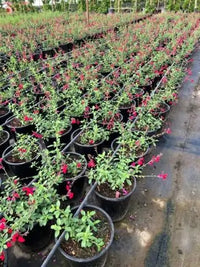


White Crape Myrtle for sale in Arizona, delivered to you
White Crape Myrtle (Lagerstroemia 'Natchez') is a summer-flowering tree with pure white blooms, peeling cinnamon bark and orange-red fall color. Natchez can reach 20 to 30 feet and is known for strong mildew resistance. Below is what to expect in a Valley yard, from size, spacing and watering to pruning, yellow leaves and summer heat.
Sourced from trusted Arizona growers and delivered directly to your door, job site, or property. We deliver across the Valley and to nearby towns, and quote delivery anywhere else in Arizona.
When does White Crape Myrtle bloom in Arizona?
It blooms in summer, from about June into September, and sometimes into October. Natchez is known for a long bloom season. The pure white flowers come in clusters 6 to 12 inches long at the ends of the branches, and bees visit them for pollen.
How much water does crape myrtle need in the Valley?
Crape myrtle is not a low-water desert tree, and it is not on the Phoenix area low-water plant list. Once rooted in, soak it 2 to 3 feet deep every 7 to 14 days in summer and every 2 to 4 weeks in winter. Young trees need water more often while they root in.
How far apart do you plant White Crape Myrtle?
Plant 8 to 12 feet apart center to center for a row where the canopies grow together. For a single tree with its trunks on show, allow 12 feet or more. At 10 feet apart, a 60 foot property line takes about 7 trees. The spacing calculator on this page does the count for you.
Why do crape myrtle leaves turn yellow in Arizona?
Our desert soils are alkaline, and crape myrtle has trouble taking up iron in them. The newest leaves turn pale yellow between green veins, and overwatering makes it worse. An iron product made for alkaline soil, applied in spring, is the usual fix, and it can take repeat doses.
How do you prune crape myrtle without crape murder?
Prune lightly in late winter while the tree is bare. Remove dead, broken and crossing limbs, suckers at the base and old seed heads. Cutting the trunks back to stubs, called crape murder, is hard on the tree and ruins its shape.
Is Natchez resistant to powdery mildew?
Yes. Natchez was selected for its mildew resistance and is rated highly for it. Mildew on crape myrtle is worst with poor air flow and shade, so plant it in full sun with room around the canopy.
Can crape myrtle handle Phoenix summer heat?
It needs heat to bloom and does best in full sun. In Phoenix, leaf edges often brown in mid to late summer, and hot west sides and heat above 115°F are hard on it. Some Tucson sources do list it for reflected sun, so opinions split on hot walls.
White Crape Myrtle bark and fall color
Natchez is known for its bark. It peels in patches to show smooth cinnamon brown trunks, which show best on a tree with several trunks. In fall the leaves turn orange and red before they drop, so the bark carries the look through winter.
We deliver across the Valley, from Phoenix, Scottsdale and Mesa out to San Tan Valley, Maricopa and Casa Grande, and up to Prescott, Sedona, Payson and Globe. See delivery areas and rates.